Hand-Cut Mosaic Art: History, Materials and Applications
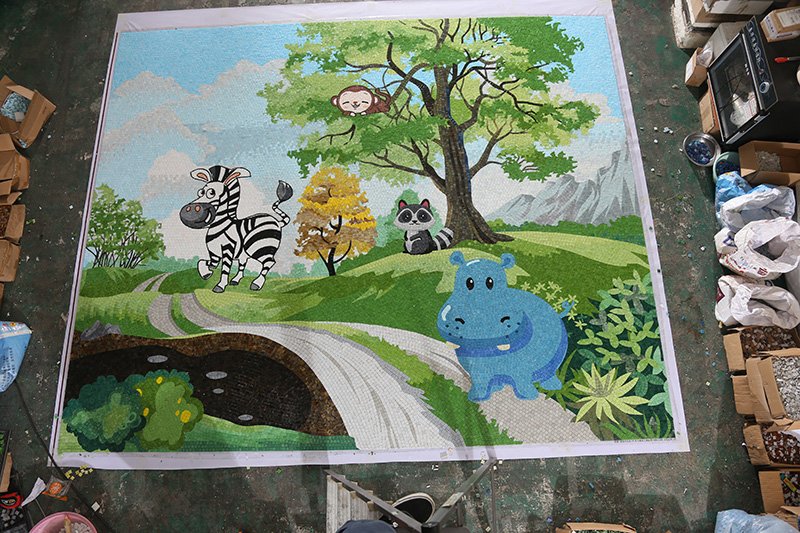
Hand-cut mosaic art turns individual pieces of glass, stone or ceramic into a picture. The pieces, called tesserae, are cut and arranged to follow the subject: a curved cheek, a zebra’s stripes or the branching lines of a tree. Colour creates the image; the shapes and direction of the pieces give it texture and movement.
This guide explains the history, materials, defining features and applications of hand-cut mosaic art. Four workshop photographs supplied by FStiles show how an animal-themed panel works at different viewing distances, from the complete landscape to the small pieces around a monkey’s face.
The opening photograph shows the complete animal-themed panel in the workshop. Photographs supplied by FStiles.
What is hand-cut mosaic art?
Hand-cut mosaic art is a picture made by cutting and assembling small pieces of material to suit a design. Unlike a printed tile image, the picture is built through physical joints between pieces. Unlike a regular mosaic grid, hand-cut work can change the shape, size and direction of its tesserae around each feature.
“Hand-cut” describes a making technique, not a particular material or installation rating. A design may start as a drawing or digital layout and still be assembled by hand. Conversely, a mosaic made from identical square tiles may also be hand-placed. The useful distinction is how closely the pieces are shaped and positioned for the image.
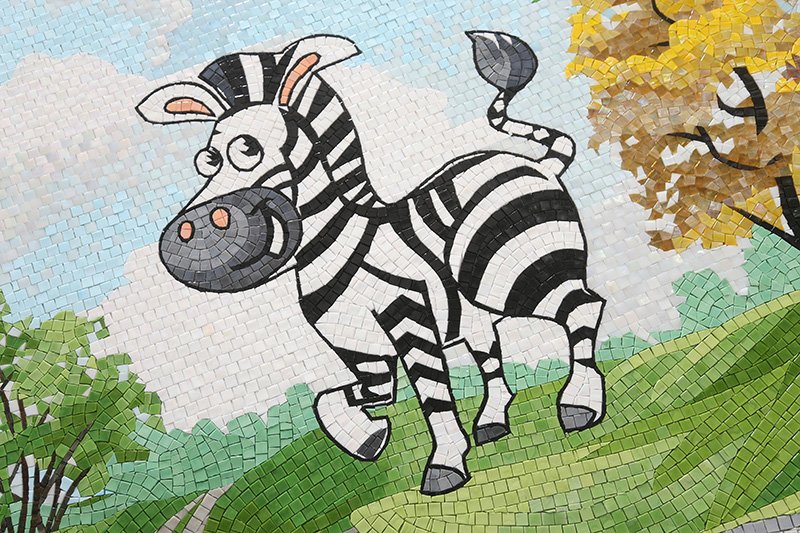
In the zebra photograph below, narrow dark pieces trace the stripes while pale pieces fill the body. The cut lines help define the animal’s rounded form. That relationship between the picture and its individual pieces is central to hand-cut mosaic design.
A short history: from ancient pavements to contemporary pictures
Greek and Roman traditions
Mosaic has a long history as both a surface finish and a way of making images. The Getty Museum describes Greek pebble mosaics and the Roman development of opus tessellatum, in which small tesserae formed architectural decoration. Roman makers created geometric arrangements as well as figures, animals and narrative scenes. Finer pieces allowed more painterly effects; glass could supply colours that were difficult to obtain from stone. [1]
Byzantine and early Islamic glass mosaics
Glass became especially important in monumental wall and ceiling decoration. The Metropolitan Museum of Art documents its use in Byzantine buildings and early Islamic monuments, including Hagia Sophia and the Dome of the Rock. These traditions demonstrate how a mosaic’s colour and light can shape an architectural interior, rather than simply decorate a flat surface. [2]
Historical tesserae were not limited to plain glass. The French Ministry of Culture’s study of the Great Umayyad Mosque in Damascus describes stone, glass and mother-of-pearl, as well as gold and silver leaf enclosed between glass layers. The material palette was already capable of producing very different visual effects. [3]
Contemporary hand-cut mosaic art
Today, the same basic act—building an image from separate pieces—can support contemporary illustrations, landscapes, lettering and abstract compositions. The animal panel in this guide uses a playful subject, but the visual decisions remain familiar: simplify forms, select colours, shape the pieces and control the joints. Its connection to older mosaics lies in the construction of the image, not in an assumption that every historical workshop used identical tools or methods.
What materials are used in hand-cut mosaic art?
Common choices include glass, marble and other stone, and ceramic. Makers may combine materials, but they must account for differences in thickness, surface and installation requirements. The name “mosaic” alone does not establish whether a panel is suitable for a floor, pool or exterior wall.
| Material | Visual character | What to confirm |
|---|---|---|
| Glass | Can offer saturated colours, translucency or a reflective finish. | Opacity, backing, thickness and compatibility with the specified adhesive and grout. |
| Smalti | A traditional mosaic glass, often selected for a varied, light-catching surface. | Actual sample finish, thickness variation and the intended setting method. |
| Marble and other stone | Natural colour variation and veining can contribute to shading and texture. | Stone identity, finish, cleaning requirements and suitability for the exposure. |
| Ceramic | Glazed or unglazed pieces can introduce different colours and surface effects. | Whether cut edges expose the body and whether the product is rated for the location. |
The photographs illustrate colour, cut shapes and arrangement. They do not establish the exact composition, dimensions or performance rating of the photographed panel. Those details should come from the project specification and material samples.
For a starting point, compare our glass mosaic tiles and marble mosaic tiles, or browse the wider mosaic materials collection.
What makes a hand-cut mosaic distinctive?
1. Pieces follow the subject
Squares are useful for broad areas, but a face or curved outline may call for smaller, tapered or irregular shapes. In the monkey’s face, the pieces change direction around the cheeks, eyes and mouth. A small red shape becomes the nose; dark pieces make the expression readable.

2. The joints become part of the drawing
The spaces between tesserae remain visible, so their width and direction matter. Rows of pieces can follow an outline, turn around a feature or establish the rhythm of a background. The flow of these rows is often called andamento. The foliage photograph shows how that flow distinguishes a rounded face from branches and surrounding leaves.
3. The image has two viewing scales
From a distance, viewers read the scene. Up close, they see the small decisions that construct it. A successful design needs both: a clear overall composition and details that reward closer inspection. More tiny pieces are not automatically better; the right size depends on the subject and viewing distance.
4. Light and grout influence the result
Glossy and matte surfaces respond differently to light. Grout colour can strengthen outlines or make a field of pieces read more continuously. Review a physical sample with the proposed grout under the intended lighting, especially when the mosaic combines pale, translucent or reflective materials.

Where can hand-cut mosaic art be used?
Interior feature walls and framed panels
A mosaic picture can provide a focal point in an entrance, living area, restaurant or reception space. Choose the subject and level of detail for the distance from which people will usually view it. A framed panel also needs an appropriate support and fixing method for its weight.
Hospitality, retail and themed spaces
Custom imagery can give a hotel, café or shop a recognisable visual identity. Animal and landscape designs may also be considered for family-oriented spaces. Where people can touch the work, the specification should address accessible edges, cleaning and the fixing system, as well as the image itself.
Bathrooms, pools, floors and exterior projects
These locations require an application-specific design. Pool immersion, exterior exposure and foot traffic place different demands on materials and installation. A decorative wall panel should not be assumed suitable for any of them. Floor projects need verified suitability for wear and slip resistance; wet installations require a compatible substrate, waterproofing, adhesive and grout system.
Mounting details matter too. LATICRETE’s technical guidance identifies the suitability of the mesh and its glue as a specific consideration for rear-mesh-mounted glass mosaics. Confirm compatibility with the mosaic and setting-material suppliers before installation. [4]
What to prepare for a custom mosaic enquiry
- Artwork and permission: provide a reference image or drawing you are entitled to use.
- Finished dimensions: specify width and height, preferably in both millimetres and inches when working across markets.
- Location: identify wall or floor, interior or exterior, and any wet or submerged exposure.
- Appearance: agree on colour samples, finish, grout and expected viewing distance.
- Installation planning: confirm substrate, mounting format, section layout and fixing requirements.
- Delivery: provide the destination country and postcode, access constraints and required schedule.
FStiles is based in Foshan, Guangdong, China. To discuss a design, visit our custom mosaic projects page or send a mosaic project enquiry. Include the intended use so material selection and installation requirements can be considered together.
Frequently asked questions
Is hand-cut mosaic art the same as pixel mosaic?
They can overlap, but they describe different approaches. Pixel mosaics usually resolve an image through a regular grid of small units. Hand-cut mosaics can shape and redirect pieces around individual features. Either approach may involve hand assembly.
Is every piece cut by hand?
Not necessarily. A hand-cut design may combine standard tesserae with individually shaped pieces. Ask which parts are cut for the artwork and request close-up photographs if the making method is important to your project.
Can a photograph become a mosaic picture?
Yes, but it requires interpretation. Fine lines and subtle colour changes may need simplifying to remain readable at the chosen size. Review the proposed layout and a representative detail before approving the full panel.
Is hand-cut mosaic art suitable for a swimming pool?
Only when the selected materials, mounting and complete installation system are suitable for continuous immersion. The fact that a picture is made from glass or small tiles is not enough to establish pool suitability.
What determines the cost of a custom mosaic?
Important factors include finished area, image complexity, material choice, cutting and assembly work, mounting, packing and delivery. Compare quotations using the same dimensions, specification and scope; an area price alone may omit substantial differences.
Sources and further reading
Historical context is based on museum and cultural-heritage sources. The photo observations above concern the supplied contemporary panel; they do not imply that it is a historical object or a certified installation.
- Christine Kondoleon, “Introduction,” Roman Mosaics in the J. Paul Getty Museum, J. Paul Getty Museum, 2016.
- Matthew Saba, “Glass Ornaments in Late Antiquity and Early Islam (ca. 500–1000)”, The Metropolitan Museum of Art, 2016.
- French Ministry of Culture, “Making tesserae,” The Great Umayyad Mosque in Damascus.
- LATICRETE, Thinsets: technical frequently asked questions, including guidance on rear-mesh-mounted glass mosaic tile.
Prepared for FStiles · 3 November 2026. Photographs supplied by FStiles.